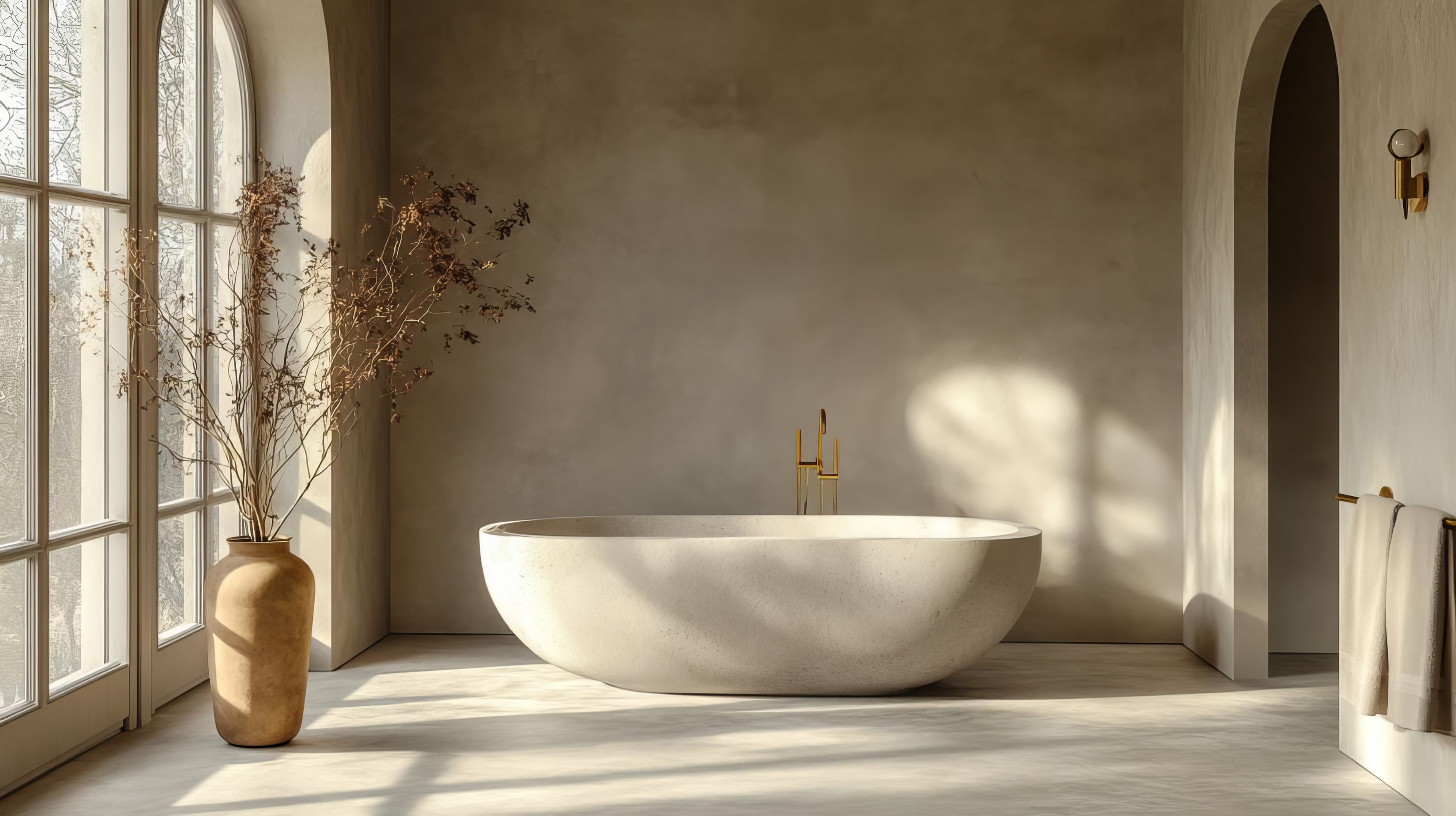
Tile has been the default choice for bathrooms, kitchens, and entryways for decades. But a growing number of homeowners and designers are choosing microcement as a tile alternative — and for good reason. If you're planning a renovation and weighing microcement vs tile, this guide covers everything you need to make an informed decision: appearance, installation, cost, durability, maintenance, resale value, and design flexibility.
Whether you're renovating a master bathroom in Dallas, upgrading a kitchen in Houston, or designing a boutique hotel lobby, the choice between microcement or tile flooring will shape the look, feel, and long-term performance of your space.
Appearance: Seamless Elegance vs Grout Lines
The most immediate visual difference between microcement and tile is continuity. Microcement creates a completely seamless surface — no grout lines, no joints, no interruptions. The coating flows continuously from floor to wall, across corners, and between rooms. Each installation has a unique, hand-crafted character with subtle trowel marks and organic color variation that looks like natural stone or polished concrete.
Tile, no matter how large the format, always has grout lines. Even with rectified large-format porcelain and minimal grout joints, the grid pattern is visible. Grout lines break up the visual flow of a room, make spaces feel smaller, and — perhaps most importantly — create maintenance headaches over time as grout discolors, cracks, and harbors mold.
Microcement is available in virtually unlimited colors and can be finished in matte, satin, or semi-gloss. The result is a monolithic, spa-like surface that makes any room feel more expansive and contemporary. If you've been searching for a true tile alternative that delivers modern, European-inspired design, microcement is it.
The Grout-Free Advantage
Grout is tile's Achilles' heel. It's porous, it stains, it cracks, it discolors, and in wet areas it's a breeding ground for mold and mildew. Homeowners spend hours scrubbing grout lines — and even with regular sealing, grout deteriorates over the years.
Microcement eliminates grout entirely. The surface is continuous and, when sealed with a polyurethane topcoat like Atriapol Antibacterial, it becomes fully waterproof and non-porous. There are no joints to trap dirt, no lines to scrub, and no risk of grout mold in your shower or bathroom. For anyone who has ever battled discolored grout, this alone can justify the switch.
Installation: Time, Mess, and Demolition
Tile installation is invasive. If you're replacing an existing floor, the old surface usually needs to be demolished — meaning jackhammers, dust, debris, and dumpster loads of broken tile. The subfloor may need leveling. Then comes the mortar, tile cutting (with a wet saw, generating noise and water spray), adhesive, grouting, and grout sealing. A typical bathroom tile job takes 5–10 working days and leaves your home in chaos.
Microcement installation is dramatically different. Because microcement is only 2–3mm thick and bonds directly to existing substrates, it can be applied over existing tile, concrete, or wood — no demolition required. The process involves primer, fiberglass mesh, two base coats, two finish coats, and two coats of polyurethane sealer. A typical bathroom takes 3–5 days with minimal dust and no heavy machinery. You skip the jackhammer, skip the dumpster, and skip thousands of dollars in demolition costs.
ATRIA PURO is our complete microcement system — primer, base coat, finish coat, and Atriapol Antibacterial waterproofing sealer — manufactured by Colorificio Atria in Sicily. The system is designed to apply directly over existing tile without demolition, delivering a seamless, waterproof surface in days, not weeks. Explore the ATRIA PURO system →
Cost Comparison: Microcement vs Tile
At first glance, tile can seem cheaper. Basic ceramic tile starts at $2–4/sqft for materials. But the installed cost tells a very different story once you factor in demolition, substrate prep, labor, grouting, and sealing. Here are realistic 2026 ranges:
| Cost Factor | Microcement | Tile |
|---|---|---|
| Material cost | $3–8/sqft | $2–30/sqft (ceramic to natural stone) |
| Professional installation | $10–25/sqft total | $10–50/sqft total (varies by tile) |
| Demolition of existing surface | Not required — $0 | $3–8/sqft (tile removal + disposal) |
| Substrate preparation | Minimal — primer over existing surface | Leveling, backer board, waterproofing membrane |
| Grout + sealing | Not applicable | $1–3/sqft + annual re-sealing |
| Timeline | 3–5 days | 5–10 days |
| Long-term maintenance | Re-seal every 5–8 years | Grout cleaning, resealing every 1–2 years |
For a 100-sqft bathroom renovation over existing tile, microcement typically costs $1,000–2,500 installed. The same bathroom re-tiled with mid-range porcelain — including demolition, disposal, substrate prep, tile, grout, and sealing — runs $2,000–5,000+. The demolition savings alone often make microcement the more economical choice, especially in renovations.
Durability: How Each Holds Up Over Time
Porcelain and ceramic tile are inherently hard and scratch-resistant. High-quality porcelain can last 50+ years in ideal conditions. However, tile's durability is only as good as its grout. Cracked grout allows water infiltration, which leads to substrate damage, mold growth, and eventually loose or cracked tiles. Most tile floors need grout repair within 5–10 years.
Microcement, sealed with a professional-grade polyurethane like Atriapol Antibacterial, has a lifespan of 15–25 years. It resists stains, scratches, and water penetration. Because it's slightly flexible (unlike rigid tile), it can accommodate minor substrate movement without cracking. The surface can be refreshed with a new topcoat rather than a full replacement, extending its life even further.
In high-traffic areas, both materials perform well. In wet areas like bathrooms and showers, microcement has an advantage: no grout joints means no weak points for water to penetrate. When combined with Atriapol Antibacterial waterproofing, microcement creates a truly monolithic waterproof surface — something tile can only approximate with additional waterproofing membranes and careful grout maintenance.
Maintenance: The Long Game
Tile maintenance revolves around grout. You'll need to seal grout lines annually in wet areas, clean them regularly with specialized grout cleaners, and eventually re-grout as joints crack and discolor. Tile itself is low-maintenance, but the grout system demands constant attention.
Microcement maintenance is simpler: sweep or vacuum regularly, mop with a pH-neutral cleaner, and re-seal with polyurethane every 5–8 years. No grout to scrub, no joints to re-seal, no mold-prone crevices to treat. For busy homeowners, the time savings are substantial — you get back the hours you'd otherwise spend on your hands and knees with a grout brush.
Resale Value & Buyer Appeal
Tile is expected — it's in virtually every home. It doesn't hurt resale value, but it doesn't create excitement either. Buyers see tile and think "standard."
Microcement creates a "wow factor." Real estate agents consistently report that homes with microcement bathrooms, kitchens, and seamless flooring generate more interest and command higher offers. The look reads as luxury renovation — the kind of detail featured in Architectural Digest and design blogs. For investment properties, Airbnbs, and homes in competitive markets, microcement provides a measurable return on investment.
Design Flexibility
Tile comes in an enormous variety of sizes, colors, patterns, and materials — ceramic, porcelain, natural stone, glass, encaustic. But every tile installation is constrained by the grid: you're working with individual units that must be laid in a pattern with joints between them. Curved surfaces, flowing transitions between rooms, and truly custom color matching are difficult or impossible.
Microcement is infinitely flexible. It can be applied to floors, walls, countertops, shower enclosures, bathtubs, staircases, and even furniture — all in one continuous surface and one consistent color. It flows around curves, into niches, and across transitions without joints. Any color can be custom-mixed. The result is a cohesive, unified design language that tile simply cannot achieve.
Microcement vs Tile: Full Comparison Table
| Feature | Microcement | Tile |
|---|---|---|
| Appearance | Seamless, natural texture with organic variation | Uniform, repetitive pattern with visible grout lines |
| Grout Lines | None — completely seamless surface | Yes — requires regular cleaning and resealing |
| Installation Time | 3–5 days (typical bathroom) | 5–10 days (typical bathroom) |
| Demolition Needed | No — applies over existing surfaces | Usually yes — old surface must be removed |
| Installation Mess | Minimal — no cutting, no dust, no grout mixing | Significant — tile cutting, mortar, grout, dust |
| Waterproof | Yes (with Atriapol Antibacterial sealer) | Water-resistant with proper grout sealing |
| Design Flexibility | Unlimited colors, seamless across rooms | Limited by tile size, pattern, and grout color |
| Maintenance | Mop with pH-neutral cleaner | Grout cleaning, resealing every 1–2 years |
| Durability | 15–25+ years with proper care | 20–50 years depending on tile type |
| Cost (installed) | $10–25/sqft | $10–50/sqft (varies widely by tile) |
| Thickness | 2–3mm total | 10–15mm with adhesive |
| Resale Value | High — luxury appeal, modern buyers love it | Standard — expected in most homes |
| Repair | Spot repair possible by trained applicator | Individual tile replacement (if spares available) |
| Eco-Friendliness | Low VOC, no demolition waste | Energy-intensive manufacturing, demolition waste |
Where Each Material Excels
Choose Microcement When:
Bathroom renovations
Seamless, waterproof, grout-free — especially showers
Over existing tile
No demolition, no dumpster, no mess
Open-plan living
Seamless flow between rooms without thresholds
Modern / minimalist design
Clean lines, monolithic surfaces, European aesthetic
Rental & Airbnb properties
Luxury look that photographs beautifully
Quick renovations
3–5 days vs 5–10 days for tile
Choose Tile When:
Decorative patterns
Moroccan, encaustic, mosaic, or patterned designs
Maximum lifespan
Quality porcelain can last 50+ years
DIY installation
Tile is more accessible for skilled DIYers
Traditional aesthetics
Classic subway tile, herringbone, or natural stone
Outdoor hardscaping
Porcelain pavers for patios and walkways
Extreme heat areas
Behind stoves, around fireplaces
Frequently Asked Questions
Can microcement be applied directly over tile?
Yes — this is one of microcement's biggest advantages. With proper priming and mesh reinforcement, microcement bonds directly to existing tile, concrete, wood, and other stable substrates. No demolition, no removal, no dumpster. The ATRIA PURO system includes a dedicated bonding primer specifically designed for overlay applications.
Is microcement slippery in bathrooms?
Microcement has a naturally textured surface that provides good slip resistance — comparable to or better than polished porcelain tile. For shower floors, additional anti-slip texturing can be incorporated during application. Combined with the Atriapol Antibacterial sealer, the result is a surface that's both waterproof and safe underfoot.
Does microcement crack?
When properly installed with fiberglass mesh reinforcement and a quality polymer-modified system like ATRIA PURO, microcement is resistant to cracking. Its slight flexibility allows it to absorb minor substrate movement that would crack rigid tile grout. Hairline "crazing" can develop over years but is considered part of the material's natural character — similar to aged concrete or natural stone.
Can I use microcement in my kitchen?
Absolutely. Microcement works beautifully on kitchen floors, walls, countertops, and backsplashes. Sealed with Atriapol Antibacterial, it resists water, stains, and household chemicals. The seamless surface is easier to clean than tile with grout — no crevices for food particles to lodge in.
The Bottom Line: Microcement vs Tile in 2026
Tile remains a solid, proven material — but it's no longer the only option. Microcement offers a seamless, grout-free, modern alternative that installs faster, eliminates demolition, and delivers the kind of luxury aesthetic that today's buyers and designers are demanding. For bathroom renovations, kitchen upgrades, and whole-home flooring, microcement is the tile alternative that's reshaping modern interiors.
Ready to explore microcement for your space? Browse our ATRIA PURO microcement system, learn about our microcement floor installation and microcement bathroom services, or contact us for a free consultation and estimate.
Ready to Ditch the Grout?
Send us photos of your space and we'll provide a free consultation with a detailed microcement estimate within 24 hours.